
By Gurpreet Oshan, RCIC-IRB
I wish it were a simple Yes/No question, however, it is not.
In the age of online education, it is time we rethink the IRPR 87.1(3)(a) and its implications.
I have been coming across too many social media videos and posts about a candidate who recently got a refusal under the IRPR 87.1(3)(a) as they had completed 2 foreign credentials from abroad while they were working inside Canada and claiming points for the Canadian Experience Class. Based on the refusal letter, the applicant seems to have declared the programs as full-time, the officer classified the programs as full-time, and deduced that applicant was engaged in full-time study, rendering the work experience as ineligible.
First things first, I do not have the facts of the case in front of me simply by looking at the publicly shared refusal letter. Second, I did not see detailed refusal reasons of the officer that led to the conclusion of finding of ineligibility for the points claimed. And when the facts of the case are not clear, I cannot give an opinion on whether the refusal is valid/invalid, correct/incorrect. And this should be something that we should refrain from, when answer is not abundantly clear, to pass blanket statements on the statutory law.
Now, let us take a look at the statutory law, IRPR 87.1(3)(a),
“Any period of employment during which the foreign national was engaged in full-time study shall not be included in calculating a period of work experience”
At first glance, the rule appears straightforward. While studying, you cannot claim the work experience. The nuance arises here with a critical question,
“What is the definition of full-time study?”
Neither the IRPA nor the IRPR defines what is the meaning of study, student, full-time study, part-time study. So, I dug up a little in the trenches, and here is what I found:
The 2014 regulatory amendments as published here: https://gazette.gc.ca/rp-pr/p2/2014/2014-02-12/html/sor-dors14-eng.html#footnote.46770
removed the prior definition of “student” and clarified the terminology around “studies” and “study permits”. No definition of full-time study was introduced to replace it. I also looked up the repealed definitions; they are defined as:
student means a person who is authorized by a study permit or these Regulations to engage in studies in Canada and who is studying or intends to study in Canada. (étudiant)
studies means studies undertaken at a university or college, or any course of academic, professional or vocational training. (études)
study permit means a written authorization to engage in studies in Canada issued by an officer to a foreign national. (permis d’études)
The removal of these definitions signals a deliberate shift away from the rigid and overbroad categorization toward contextual application. Following this, the term “study” has been used in IRPR in relation to study permits, being enrolled at Designated Learning Institutes, and compliance under section 220.1 of IRPR. This seems to be indicative of the term “study” being used as a regulated immigration concept, rather than an academic one. And this is also where the gap stems from. IRCC relies on institutional definitions of full-time study or part-time study.
While DLIs come under the Regulatory framework, does IRCC have the authority over foreign institutions as well?
In the next part, I want to explore the Canadian Experience Class program. When it was conceived (See OP25), CEC had two structured pathways. One pathway was for foreign workers in Canada which required 2 years of work experience, and the second pathway was for international students in Canada, where Canadian education played a big role. At that time, separate work permits were issued for off-campus work allowing 20 hours of work, co-op work permits allowing FULL-TIME WORK while being a FULL-TIME STUDENT, and Post-graduate work permits issued upon completion of studies. The requirement for education was eventually removed when CRS was introduced, and CEC requirement was reduced to one-year of work experience. The competition was introduced through points for Canadian education, and Canadian work experience, giving a relative advantage to students who came to Canada and work here. (Not talking of today, but when CRS draws were at 440-450).
The Ministerial instructions now say this
15(7) For the purposes of this section,
(a) a period of employment during which the foreign national was engaged in full-time study is not to be included in calculating a period of work experience;
(b) a period of self-employment is not to be included in calculating a period of work experience referred to in paragraph (3)(b);
(b.1) a period of unauthorized work is not to be included in calculating a period of work experience;
(c) the foreign national must have had temporary resident status during their period of work experience and any period of full-time study or training; and
(d) the full-time equivalent for part-time work experience is 30 hours of work per week.
The regs say this:
87.1(3) For the purposes of subsection (2),
(a) any period of employment during which the foreign national was engaged in full-time study shall not be included in calculating a period of work experience;
(b) any period of self-employment or unauthorized work shall not be included in calculating a period of work experience; and
(c) the foreign national must have had temporary resident status during their period of work experience.
When reading IRPR 87.1(3)(a), it cannot be read in isolation without (b) and (c) as well. It includes three things: exclusion of work during full-time study, exclusion of unauthorized work and self-employment, and requirement for a valid temporary status for eligibility for CEC and form a coherent framework. These regulations seemed to be designed to exclude unauthorized work, work that is not verifiable, and work that is not reflective of the genuine labor market participation.
The concept of work while studying comes across the study permit conditions, the co-op work permits, the PGWP eligibility, and the IRCC program delivery instructions. All of these concepts are built around the Canadian and regulated education. The closest IRCC comes to operationalizing the full-time study is under the PGWP process wherein one of the requirements for the study permit to be issued is that the students must be enrolled FULL-TIME, at a DLI, with structured academic participation, and subject to compliance obligations, such as, maintaining full-time status. Here, full-time study is not just a label, it is a regulated status in a restricted environment. At different places, the IRCC website FAQs, or PDIs, reference exclusion to study permit contexts – eg. Work experience gathered while on a co-op permit.
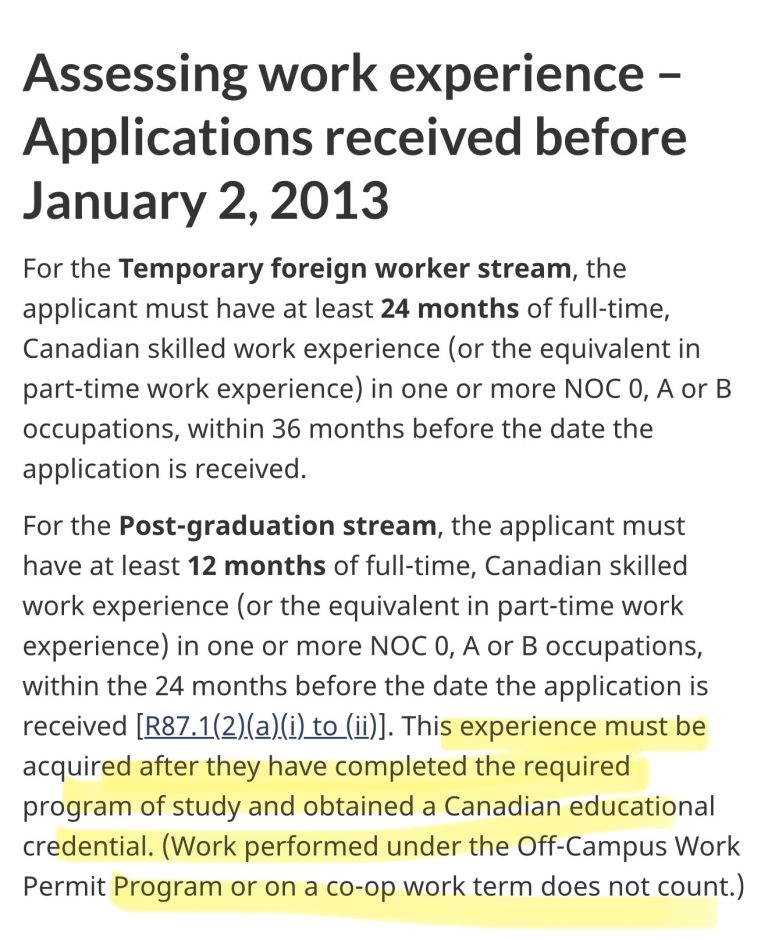
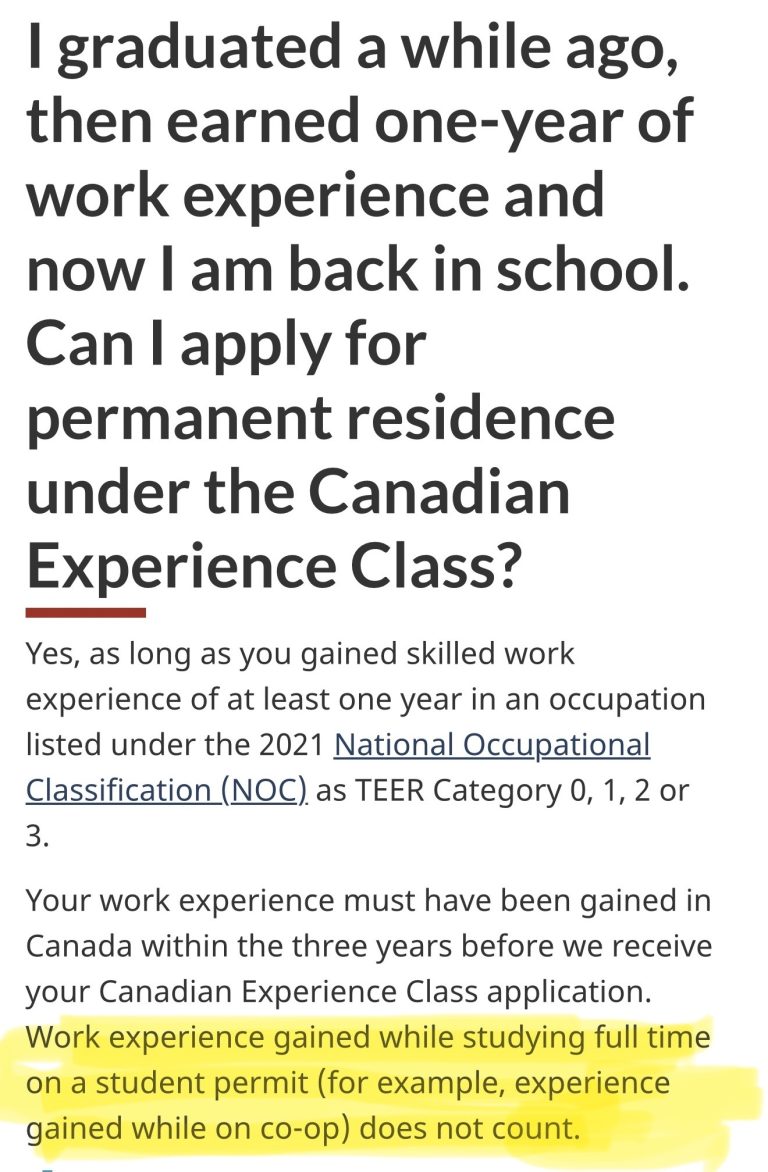
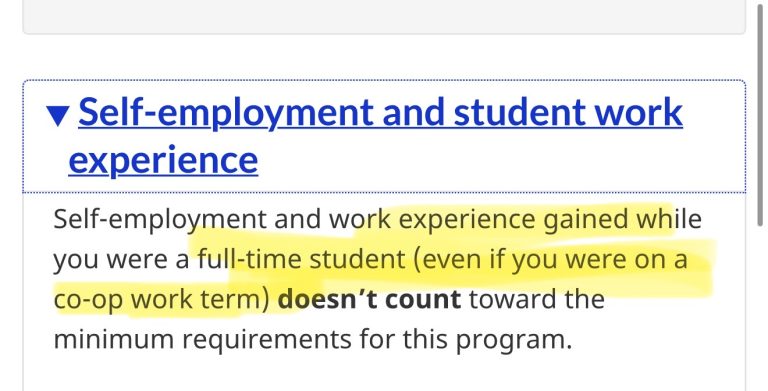
The question I have is can this same understanding be applied to a foreign, online, asynchronous education while the candidate is in Canada on a work permit pursuing the distance ed program?
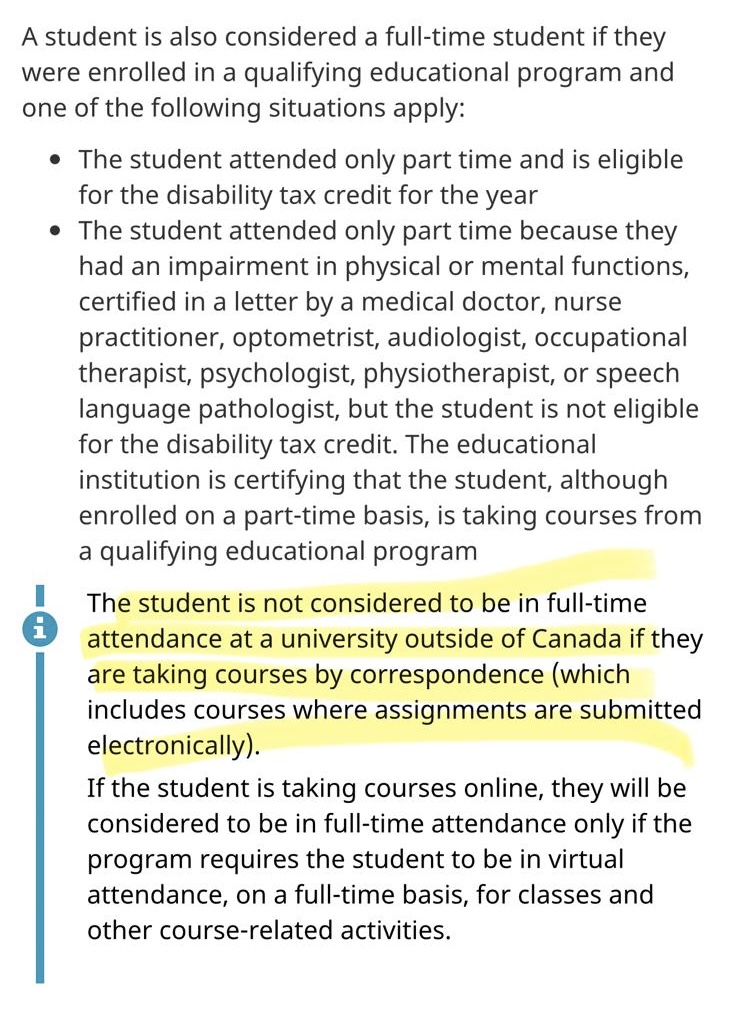
In my research, I came across a definition from CRA for what constitutes a full-time study, Even under the CRA definition, correspondence courses are not automatically considered full-time study. Yes, I know it is not IRPA and IRPR, but the treatment of foreign education in other federal regimes such as the Income Tax act, under the broader framework of Canadian laws, further supports the contextual interpretation of IRPR 87.1(3)(a). It is the same federal system after all.
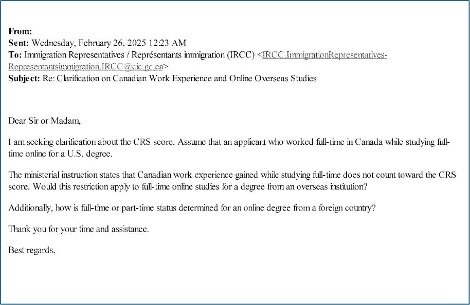
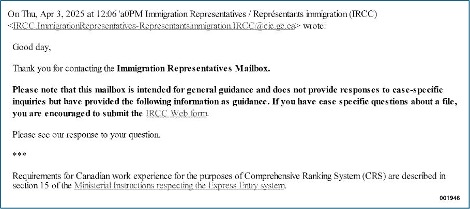
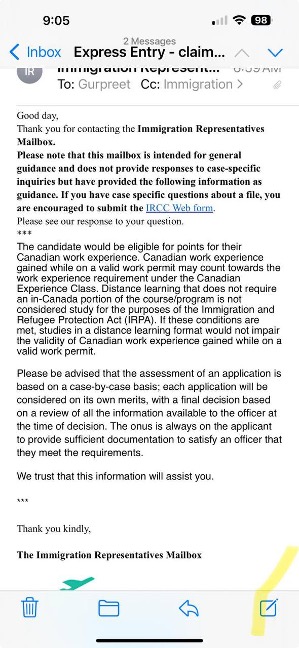
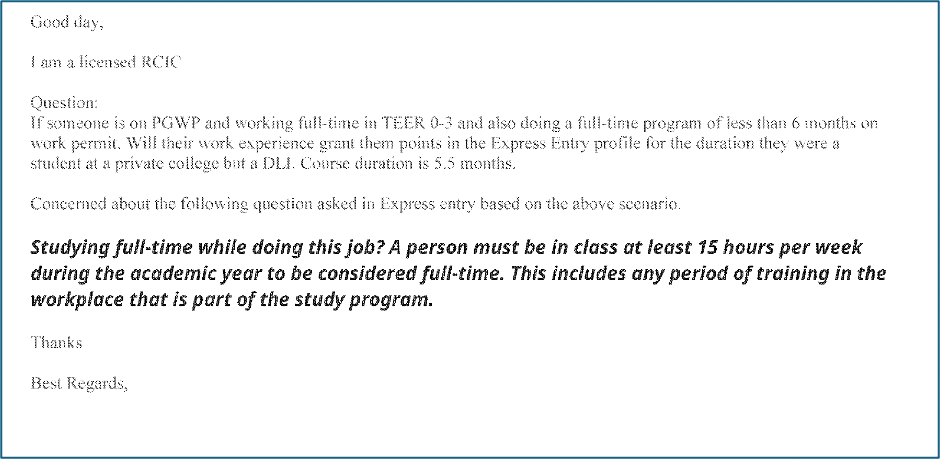
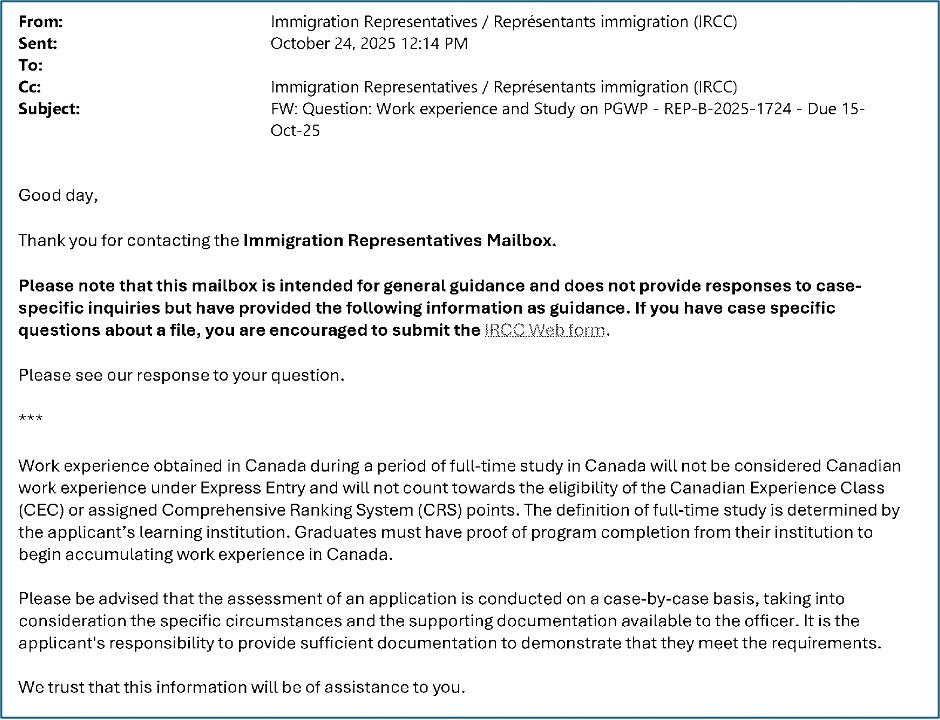
Let us now explore the responses from IMM Reps Mailbox, where in practice, many practitioners turn to get guidance on interpretations of statutory law. In their responses, not once, but at least 2 I have come across, IRCC has consistently indicated that the foreign distance education may not be considered “Study” for certain regulatory purposes, and that Canadian experience may still be accumulated alongside such programs. In another example, the candidate was doing a short-term course in Canada while on a wrok permit and the response clarifies that that experience cannot be counted towards CEC. These responses, while not case-specific decisions, do point out what it means to study under the regs. If these responses formed a part of PFL response, they may form evidentiary context, and I do understand that the persuasive value of this is limited. From practice point-of-view, your application, your response to ADRs and PFLs, all are the foundations for a future litigation record (if need be), and should be addressed with due care and diligence. Following are the three examples of responses from Imm reps mailbox.
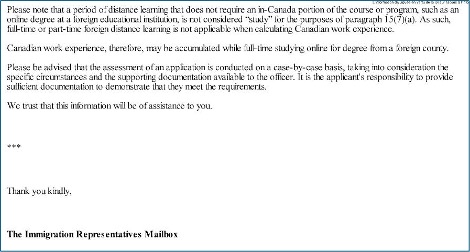
With all this, I leave it up to your interpretation. A harmonious reading of IRPR 87.1(3)(a)-(c), the available context and policy documentation, it may be a reasonable interpretation that the exclusion applies to work performed while the applicant is engaged in full-time study within a regulated immigration context, where such work is incidental or constrained by their status as a student. Does this extend to independent foreign education? I don’t think the law should be oversimplified in such a situation with a blanket exclusion rule. A literal interpretation of IRPR 87.1(3)(a), one that includes all forms of full-time study globally, produces problematic outcomes. It would include foreign online degrees, professional certifications, employer-sponsored training programs, and case can be made for language courses even. Such an interpretation risks extending the provision beyond its purpose and producing unreasonable results.
Signing off with lines from my favorite, RBG, “Law is not what is written. It is how it is interpreted.”
If you are unsure whether your education qualifies for CRS points, this is not something to guess.
A small mistake in how your profile is built can cost you an invitation or lead to issues later in the process.
If you want your profile reviewed strategically, you can book a consultation here.